.webp)



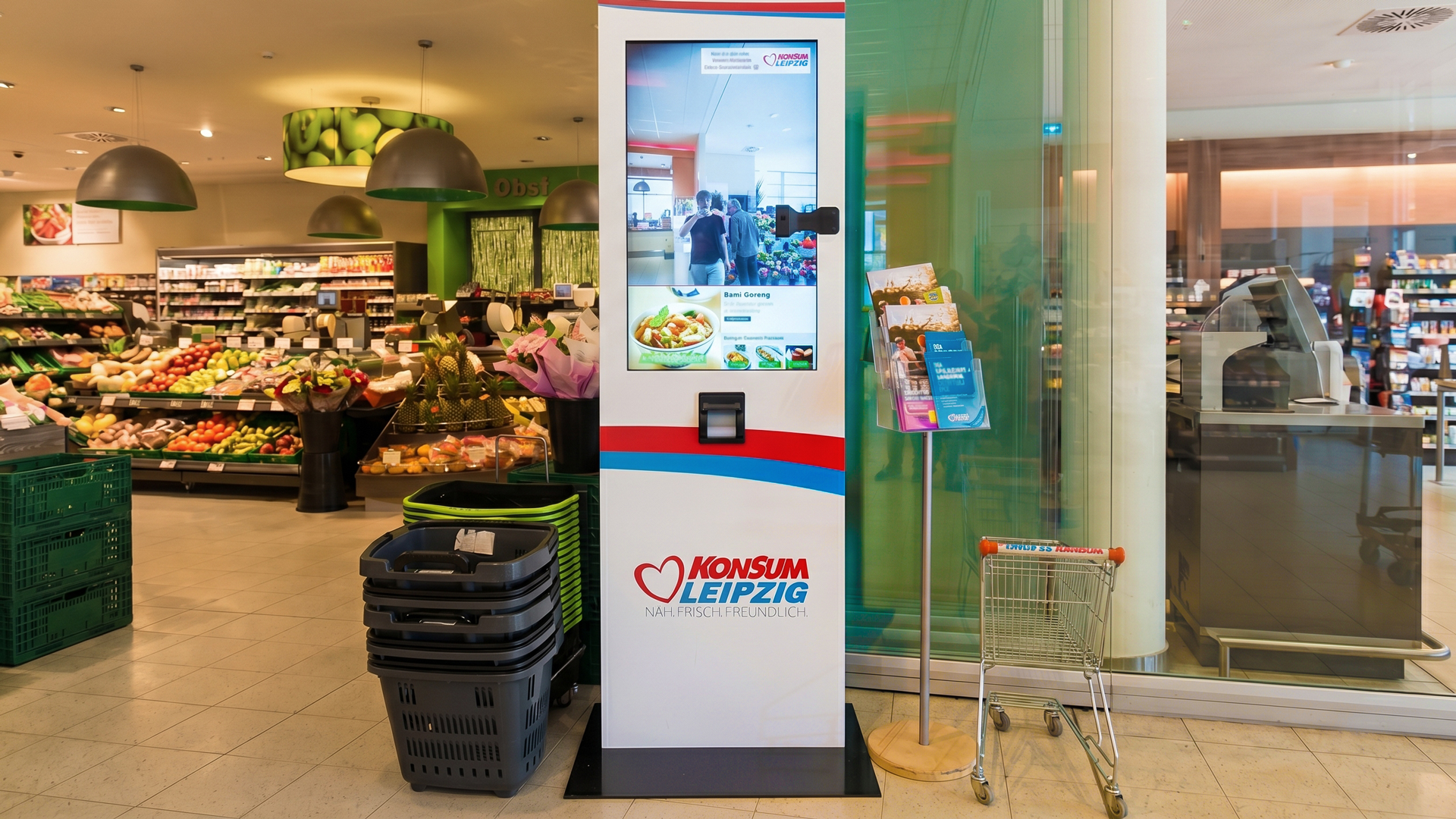
In 2017, Rico Manß and Prof. Dr. Manfred Kirchgeorg from HHL Leipzig Graduate School of Management published an independent academic study in Marketing Review St. Gallen (Issue 4/2017, pp. 24–32) examining the effectiveness of cross-media integration technologies in retail. At the centre of the experimental design: a Sensape Magic Mirror installed at the entrance of a Konsum Leipzig grocery store.
The Experimental Setup
The Magic Mirror was placed at the store entrance over a two-week field phase. Built-in sensors and computer vision software estimated visitor age and gender, then triggered tailored Augmented Reality interactions on the screen — showing the customer's own mirror image alongside personalised speech bubbles and featured products.
- Location: Konsumgenossenschaft Leipzig eG store
- Duration: 2 weeks
- Sample: ~12,000 store visitors (avg. 1,023 contacts per day)
- Comparison: Ad-free reference period and reference store with classic flyer advertising
The Results
Engagement: 71%
71% of all store visitors began an interaction with the screen — nearly 3 in 4 customers willingly engaged with the digital medium during their offline shopping journey.
Sales uplift at product-family level
Compared to the ad-free reference period (=100%), products advertised via classic flyers in the reference store reached 129%, while products advertised via the Sensape Magic Mirror reached 198% — a 3.36× uplift versus traditional flyer advertising.
Sales uplift at single-product level
At the single-product level, the effect was even stronger: 119% for the flyer reference vs. 204% for the Magic Mirror — a 5.44× uplift versus flyer advertising.
Dwell time and demographics
Average dwell time was 8.9 seconds across all customers, but rose to 14.7 seconds for visitors under 30 — confirming that younger audiences engage longer with AR-driven point-of-sale media.
Category-specific effects
The effect varied considerably by product category. A yogurt product showed sales increases of over 300%, while a cake product showed no measurable lift. This points to a category-specific suitability for AR-driven POS marketing — and is a useful guide when selecting products to feature.
Why This Matters
Independent academic studies of point-of-sale technology are rare. Most retail-tech vendors cite internal numbers or marketing claims. This study, conducted by a top-ranked European business school and published in a respected peer-reviewed marketing journal, provides external validation of what Sensape customers see in practice — and it has been indexed by RePEc, EconStor, and the broader academic citation network.
The implications go beyond the specific Magic Mirror experiment. As the authors argue, cross-media integration technologies have disruptive potential for retail — they bridge the offline-online gap that traditional channels cannot close.
Citation
Manß, R., & Kirchgeorg, M. (2017). Kundenbindung durch crossmediale Integration – Die Offline-Online-Integration am Beispiel eines Magic-Mirror-Experiments. Marketing Review St. Gallen, 4/2017, pp. 24–32.
Read the full study
- Open-access PDF on EconStor (ZBW – Leibniz Information Centre for Economics)
- Bibliographic record on RePEc / IDEAS
- HHL Leipzig – Chair of Marketing
See the Technology
The Magic Mirror technology featured in the study is available today as part of Sensape's product portfolio. Explore the in-store Magic Mirror, the Recognition Box, or contact us for a custom AR solution for your retail environment.